Sunday, November 16, 2025

A Life Dedicated to Indian Intellectual Traditions: Interview with Prof V N Jha


A Life Dedicated to Indian Intellectual Traditions: 

An Interview with Prof. Vashisht Narayana Jha by Shivanand Kanavi

Prof. V.N. Jha (b. 1946) is an eminent Sanskrit scholar renowned for his multidisciplinary approach, making ancient Indian knowledge systems relevant to contemporary studies. A former Director of the Centre of Advanced Study in Sanskrit, University of Pune, he was also the founding Chairman of the Centre for Sanskrit Studies at JNU.

His expertise spans Veda, Vyākaraṇa, Nyāya, and Mīmāṃsā. Prof. Jha pioneered new academic disciplines by creating innovative courses in Sanskrit Linguistics and Indian Logic & Epistemology. A prolific author, he has contributed over 45 books and 100 research articles and supervised 35 PhD students.

He has been a visiting professor at universities in Japan, Germany, Switzerland, and Mauritius, promoting Indian intellectual traditions globally. Honoured with titles like ‘Sanskrit Mahāmahopādhyāya’ and ‘Vācaspati’, his life's work, continued through the Rishi Rina Trust, is dedicated to reviving scholarly interest in India's profound philosophical heritage through intensive workshops and textual study.


Shivanand Kanavi: Sir, Namaskara. It gives me great pleasure to speak with you. I have been attending your lectures and workshops for over eight years and have greatly benefited from your knowledge and unique style of teaching. I’ve seen you in at least six or seven workshops, each with 40-50 students from all over India and abroad.

You teach with immense empathy, whether the student is a PhD scholar, a faculty member, or a complete novice like me with no background in Sanskrit. You patiently explain complex concepts and answer all our questions. I am very grateful.

I would like our audience to know about your journey. What attracted you to Bharatiya Darshanas? How did it all begin?


Prof. V.N. Jha: I hail from West Bengal, from a small town called Raiganj. I was born on July 20, 1946. My family originally came from a village in Dinajpur district, which became part of East Pakistan after Partition. Anticipating this, my father moved us to Raiganj before partition.

I never attended primary school. In those days, it was optional, and education often began at home. One day, my grandfather decided I was ready for high school. He took me to a primary school headmaster, Gopal Chandra Mandal, to assess if I could be admitted directly into Class 5. The headmaster asked me a few questions, and I must have answered satisfactorily because he advised my father to admit me directly to high school.

I joined the famous Coronation High School in Raiganj. From Class 5, we had Sanskrit. My Sanskrit teacher, Sita Kanta Acharya, became my real guru. Seeing me in traditional dress, he took a special interest. After class, he invited me to his home. He had me play with his children for an hour, and then at 6 PM sharp, my studies would begin.


He ran a traditional pathshala called Madhusudana Chatushpathi, where the four Vedas were taught. He was a great grammarian. This is how I was introduced to the traditional method of learning Sanskrit and the Shastras. My grandfather used to recite Ashtadhyayi and Amarkosha every morning, so I had already absorbed much of it passively. My formal training began under Sita Kanta Acharya, and I progressed through the traditional levels, earning titles like Nyayacharya Tirtha and Veda Tirtha while still in school.

Simultaneously, my father was a devotee of the Gaudiya Math, an ashram on the bank of the river near our house. Every morning, we would go for the aarti. A scholar there, Surendranath Das, would gather the children afterwards and teach us Sanskrit, Mathematics, and English—completely outside the school syllabus. This selfless work ignited a deep interest in these subjects, especially mathematics.

After higher secondary, I went to college and, without telling my father, took admission in Mathematics Honours. My father’s friend, a Sanskrit professor at the same college, Ligon’s College (now a university), informed him. My father took me to college and changed my course. A compromise was reached: I did my graduation with Sanskrit Honours and Mathematics as a subsidiary subject.


After graduation, my father wanted me to go to Kashi. I went to Banaras Hindu University (BHU) and did my MA in Sanskrit with a Vedic group. There, a teacher noticed my interest in language and structure and advised me to do another MA in Comparative Philology. I sought my father’s permission, and he encouraged me to keep studying. So, I went to Calcutta University for another MA.

This exposed me to the European perspective on Sanskrit—historical linguistics, the Indo-European language family, and the Aryan invasion theory. It gave me a new vision to complement my traditional training.

After my exams, I took a job as a Sanskrit professor at a new college in the Sundarbans. But then I saw an advertisement for a Centre of Advanced Study in Sanskrit at the University of Pune, offering scholarships for a PhD. I applied, was selected, and resigned from my job to move to Pune in 1968.

For my PhD, I wanted to work on the Padapatha of the Rigveda by Shakalya. To break the continuous Samhita text into individual words (Padapatha), Shakalya must have had a deep knowledge of grammar—a grammar that is pre-Paninian. My goal was to reconstruct that grammatical knowledge. My guide, the great linguist A.M. Ghatge, directed me to work under the renowned grammarian Prof. S.D. Joshi at Pune University. This work allowed me to understand not just the history of the Sanskrit language but the history of Indian grammatical thought.


After submitting my thesis, S.M. Katre, the director of Deccan College, invited me to join a massive UNESCO project: the Dictionary of Sanskrit on Historical Principles. Working there, I met two stalwarts who truly shaped my intellectual journey: Shivaram Krishna Shastri, a grammarian and Mimamsaka, and Srinivas Shastri, a Naiyayika and Vedantin. For 17 years, I studied under them, reading texts line by line—Sutra, Bhashya, Vritti, Tikā—understanding the entire history of thought in these systems. I would translate what I learned into English and have them verify it the next day. This shifted my focus from pure grammar to Mimamsa, Nyaya, and other Darshanas.

Later, Prof. S.D. Joshi created a post for Indian Logic at Pune University and invited me to join. I did and eventually became the director of the Centre of Advanced Studies in Sanskrit, serving for 20 years until 2006.

In 2001-2002, I took two years' leave to establish the Centre for Sanskrit Studies at Jawaharlal Nehru University (JNU) at the invitation of then-Chancellor Karan Singh.

My work also took me abroad. In 1988, I taught Indian Logic at Humboldt University in Berlin. I had collaborations with universities in Japan (Nagoya, Tokyo, Osaka) due to the strong interest in Japan in the Bouddha -Nyaya dialogue. I also taught as a visiting professor in Mauritius and at the University of Lucerne in Switzerland.

Shivanand Kanavi: This is a fascinating journey. When and why did the idea of establishing the Rishi Rina Trust come about?

Prof. V.N. Jha: The idea came from a deep-seated pain. From my childhood, I was exposed to these profound knowledge systems. Simultaneously, I was in the modern education stream. I could see the clarity and depth in our traditional systems, like Sanskrit grammar, which was often missing elsewhere.


I always felt this knowledge should be made available to everyone and integrated into mainstream education. At the Centre of Advanced Studies, I created new courses like an MA in Sanskrit Linguistics and an MA in Indian Logical Epistemology, designed to be 50% traditional and 50% modern. The goal was to start a dialogue between the two traditions.

Unfortunately, the university system was often resistant to such reform. The then UGC Chairman once heard me lecture and asked me to design a common course for all Sanskrit departments in India, I worked hard to create it but sadly it wasn't implemented. Teachers weren't trained to teach it.

My wife, Prof. Ujjwala Jha, who was also a scholar of Nyaya, Veda, and Buddhism, told me that we could not depend on the system Sanskrit studies in our Universities to reform themselves despite all our effort but we have to share what we had learned. Thus, we established the Rishi Rina Trust.

The name is significant. In Dharmashastra, we speak of three debts (rina): to the sages (rishi), to the ancestors (pitr), and to the gods (deva). The only way to repay the debt to the sages is to teach what you have learned from your guru. This is rishi rina. That is the trust's mission: to repay our debt by disseminating this knowledge.

Through the trust, we conduct workshops all over the country and abroad, focusing on textual study of original texts in Sanskrit. We have covered all six Astika (Vedic) Darshanas. But a true understanding requires dialogue with Nastika (non-Vedic) systems like Charvaka (classical Indian materialism), Buddhism and Jainism as well. Our tradition itself created models for such dialogue, like Vatsyayana's method, which focuses on four points of discussion to find common ground without sacrificing one's worldview.


Shivanand Kanavi: In the last 20-25 years, how many such workshops have you conducted?

Prof. V.N. Jha: I have lost count. Every year, we conduct many. Each has pver 40 students from diverse backgrounds. The response has been very encouraging.

Shivanand Kanavi: People often have prejudices about Indian philosophy—that it is dogmatic, other-worldly, or was restricted to a certain caste. How do you address this?

Prof. V.N. Jha: These notions exist out of ignorance, a lack of exposure. If you actually study a small text, you will see these claims are false. The very existence of multiple interpretations of the same Upanishads—Shankara, Ramanuja, Madhva, Nimbaraka—proves that rationality and debate were celebrated, not suppressed. There was immense freedom of thought.

The purpose of Darshana is not just philosophy (love of wisdom) but realization and transformation—to create a better, more empathetic human being who can see unity in diversity. This knowledge is holistic and human-centric.

Even if there were restrictions on who is eligible to study these systems in the past, today, anyone can learn it. There are no restrictions. In our workshops, we have people from all communities, faiths and often more women than men. The knowledge is there for anyone who is curious.

Furthermore, only about 5% of Sanskrit literature is "scriptural"; the other 95% is secular—covering mathematics, law, medicine, aesthetics, and politics. The analytical tools developed in Nyaya or the algorithmic structure of Panini's grammar are incredibly relevant for fields like computer science and law. I taught Nyaya to law students for 16 years, training them to distill court judgments into the five-step Nyaya syllogism. This sharpens their logic, language, and discourse skills.

We lost this because we kept importing educational models from outside that had no connection to our cultural and intellectual strengths. We have to blame ourselves, not Macaulay. It is our responsibility to reintroduce this into mainstream education.

Shivanand Kanavi: Your point about the need for dialogue is crucial. The traditional method of vada, which requires first understanding the opponent's view (purvapaksha) is really absent today's chaotic debates especially in the media and polity.

Prof. V.N. Jha: Absolutely. Vada aims at arriving at the truth. The other forms, jalpa (quibbling) and vitanda (destructive criticism), are what we see today. The Navya-Nyaya scholars even developed a precise, technical language to avoid the ambiguities of natural language during debate—a concept incredibly relevant in today's world of computer science and machine learning.

This knowledge can teach us how to disagree respectfully and intelligently. That is what we need today.

Shivanand Kanavi: Thank you so much, Sir, for sharing your incredible journey and insights.

Prof. V.N. Jha: Thank you. My only request is: become a volunteer. Learn Indian intellectual traditions. Don't depend on secondary sources. Go to the original texts. And share your knowledge and understanding. This is the only way to repay our debt to the rishis.


For those interested in Prof. Jha's work and the workshops, please visit: www.vidyavatika.org

Shivanand Kanavi, is a theoretical physicist, business journalist and former Vice President at TCS. He is the author of the award winning book Sand to Silicon: The Amazing Story Of Digital Technology  and edited Research by Design: Innovation and TCS. Can be reached at skanavi@gmail.com


Saturday, November 8, 2025

Interview with Prof M Vidyasagar Part 2


The second part of my interview with Prof M Vidyasagar, FRS has appeared in Rediff


( https://www.rediff.com/news/interview/we-arent-security-conscious-as-a-nation/20251106.htm )

'We Aren't Security Conscious As A Nation'


Last updated on: November 06, 2025 14:59 IST

'Government officials use Gmail and ordinary phones without basic security consciousness.'
'Interoperability, especially in joint exercises with countries like the US, worries me.'
'It often means we open our systems to them, but they don't reciprocate.'
'They could have kill switches in their systems and might even be able to affect ours.'


Prof M Vidyasagar, FRS
(Photo Courtesy Palashranjan Bhaumick)
 

Professor M Vidyasagar, FRS, is a Distinguished Professor at IIT Hyderabad. He earned his BS, MS, and PhD in electrical engineering from the University of Wisconsin.

His distinguished career includes academic positions at universities in the USA and Canada, followed by leadership roles as Director of India's Centre for AI and Robotics and Executive VP at Tata Consultancy Services.

He held a chaired professorship at the University of Texas in Dallas before his current position.

A major feather in the cap of his team at the Centre for AI and Robotics is the creation of world class digital control software for the Light Combat Aircraft Tejas indigenously.

His research interests span stochastic algorithms, convex/nonconvex optimization, reinforcement learning, and machine learning, with recent work focusing on the theoretical foundations of stochastic gradient descent and Large Language Models.

Professor Vidyasagar, a prolific author of 13 books and over 160 peer-reviewed research papers, was appointed a Fellow of IEEE (the largest professional engineering body in the globe) for his advanced contributions to Control Systems at a very young age.

His groundbreaking contributions have been recognized with numerous prestigious honours, including Fellowship of The Royal Society (FRS), the IEEE Control Systems Award, the Rufus Oldenburger Medal (ASME), and the John R Ragazzini Education Award (AACC).

He is also a Fellow of multiple national academies in India and a recipient of a SERB National Science Chair.

"Agreements like BECA (Basic Exchange and Cooperation Agreement) involve sharing geospatial data, which is very dangerous. But too much attention is being paid to getting a 'seat at the high table' than looking after our national interest," Professor M Vidyasagar tells Shivanand Kanavi in the concluding segment of a must-read interview.

How long did the control law development for Tejas LCA, take, and what did it involve?

The first cut was ready in about two years.

The airframe shape was frozen, but the aerodynamics -- how it behaves at various altitudes and velocities -- was still being understood through wind tunnel tests.

The initial development validated our design philosophy. As we got more aerodynamic data, we expanded the flight envelope.

The design philosophy was based on solving complex, coupled non-linear equations--and the most modern control theory which traditional houses like BAE didn't use.

They were using methodologies from the 1940s.

A digital fly-by-wire system means a sequence of bits is generated in real time and sent to the wings or weapons systems.

This is especially critical for a light aircraft like the LCA, where the munitions can weigh almost as much as the plane itself.

The act of firing a missile must also automatically cause the plane to pitch up to avoid being hit by it -- this must be embedded in the control law, not left to the pilot.

The control law itself isn't computationally intensive to design, but the real-time simulation is.

You must solve those non-linear equations in milliseconds to simulate the aircraft's response to pilot inputs and various failure scenarios.

This requires immense computing power, which we lacked in India at the time.

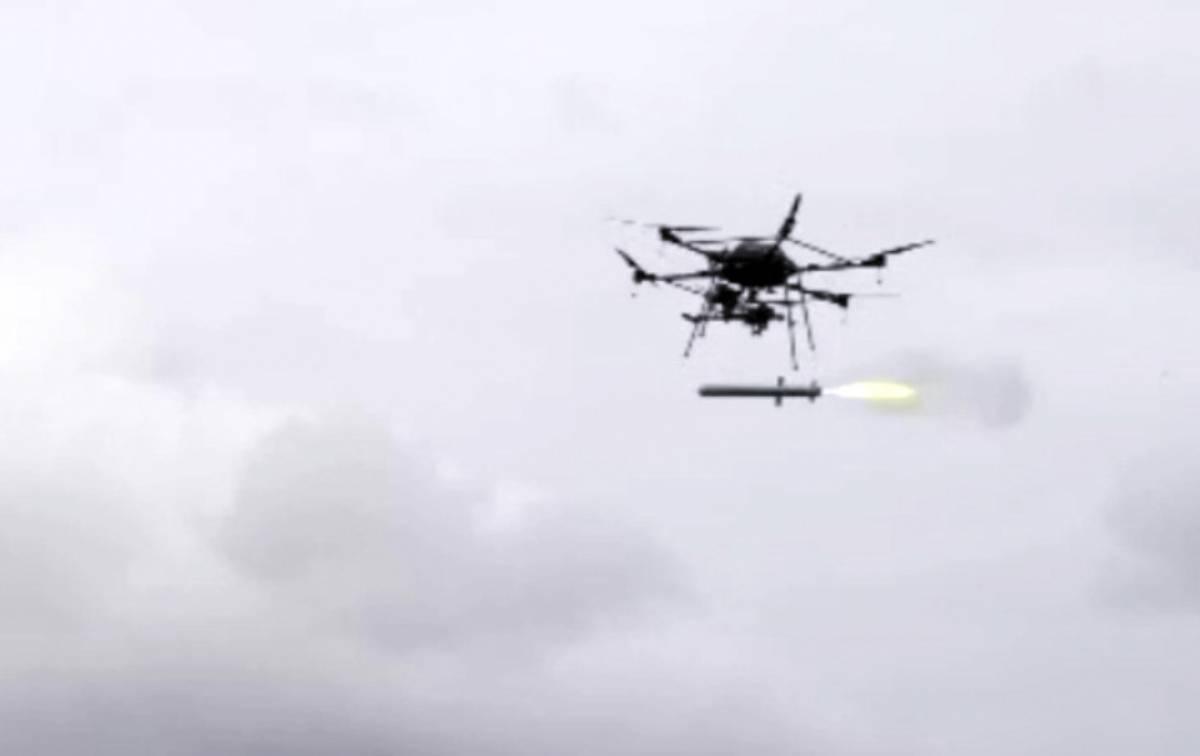
IMAGE: DRDO conducts successful flight-trials of the Advanced Unmanned Aerial Vehicle Launched Precision Guided Missile-V3 (ULPGM)-V3 at the National Open Area Range (NOAR) test range in Kurnool, Andhra Pradesh. Photograph: PIB/ANI Photo

A major hurdle for the LCA was engine development, which wasn't your area. What is your perspective on why developing an engine ourselves has been so challenging?

Mine is a second-hand impression. The challenge is as much materials science as aerodynamics.

The turbine blades in a high-thrust engine operate with tiny clearances at tremendous speeds (6,000 to 7,000 RPM) and high heat.

The blades deform, so the material must have extremely rugged thermal and mechanical properties.

Mastering the manufacturing of these high-quality turbine blades is the biggest hurdle.

Once you have that, the engine control part is manageable.

I don't know if the Kaveri engine project at GTRE was scrutinised with the same intensity as our control law team.

Perhaps if it had been given a true national priority status, a multi-lab, multi-institutional effort involving universities, things might be different.

It's a glaring failure that 20 years later, we don't have an indigenous engine of required thrust.

IMAGE: A view of a Laser Weapon developed by the Defence Research and Development Organisation to shoot down aerial targets in Kurnool. Photograph: ANI Photo

Technology transfer can work, as seen with the Canadian natural uranium nuclear reactors; the Vikas liquid rocket engine from Ariane/ ESA; and the nuclear submarine.

In each case, Indian teams were smart enough to absorb the design philosophy and even improve upon it. But a jet engine is a more difficult technology.

Even the Chinese haven't fully succeeded yet; they still use Russian engines.

The prudent thing might be to future-proof the LCA program by having engine production facilities in India through partnerships with companies like GE or Rolls-Royce.

If they set up a plant here, it's hard to pull out. But we must also intensify efforts at GTRE.

The DRDO structure isn't well-suited for this. ADA, being a society, had some flexibility.

We once requested to pay a 20,000 rupee per month (non-pensionable) incentive to key engineers for five years.

It was denied because someone in Delhi thought, "How can these engineers make more than I do?"

This mindset -- that patriotism alone should be enough -- is a major barrier.

Lockheed Martin doesn't care what a government employee earns; they pay what's needed to get the talent.

IMAGE: The Armament Research and Development Establishment, DRDO, has developed an indigenously designed Close Quarter Battle Carbine for the Indian armed forces primarily for urban warfare, anti-terror operations, and close-quarters engagements, in Pune. Photograph: Video Grab/ANI Photo

The private sector's entry into defence production is good, but the defence procurement process is unpredictable.

It's highly predictable that it will be delayed! So companies like Kalyani and L&T are looking at export markets first for their guns and tanks.

The risk is that if their market is export, why would they stay in India?

They might move to a cheaper location. While some industrialists are patriots, they also have an obligation to shareholders.

It frustrates me that these systemic issues are well-known but there seems to be no attempt to fix them.

Let's move to your time at TCS. You worked on cryptography, public key infrastructure, and bioinformatics. What was your approach and philosophy there?

I was fortunate that TCS CEO, S Ramadorai, had a very enlightened view.

He told me, "Investment in R&D is an act of faith. Nobody can really track the return on investment."

He hired me in a very direct way.

After I left DRDO, I sent him a letter outlining technologies I worked on that could be useful to TCS.

He called me a few days later and simply said, "When are you joining?" When I asked what I would do, he said, "We'll sort it out later."

At TCS, we were a showpiece, like Bell Labs or Motorola's research wing, demonstrating technical depth to clients.

The bioinformatics group, for instance, helped win deals by showing cutting-edge capability, even if not used directly on the project.

The public key infrastructure (PKI) group became the largest issuer of digital certificates.

After the US passed the Millennium Digital Signature Act in 2000 and India passed its IT Act in 2001, I saw a big market.

Another company simply imported a foreign vendor's 'sealed jar' software. Whereas we wrote our own PKI software at TCS.

A funny story illustrates the value of self-reliance.

The NSDL wanted to use PKI for their depository record access.

They installed our software, and soon called me angrily because it was rejecting all clients.

The problem was names with apostrophes, like D'Costa or D'Mello -- common among Goan Christians.

Our software flagged the apostrophe as an illegal character. We fixed it in a week.

The company that imported their software had the same problem but couldn't fix it because they didn't have the source code.

They had to go back to the foreign vendor, who essentially asked, "How big is the Indian market? Not worth it."

That's why self-reliance is crucial.

We also worked on Indian language technology. We improved the rendering of Indian language characters in early browsers.

The Swaminathan Foundation approached us to help farmers access information in local languages.

We created a bootable version of Red Hat Linux on a CD (since power outages were common) that had a fully Indian language-friendly interface.

You could have the desktop in Gujarati but type a document in Tamil.

We gave it to them -- it was a form of CSR before the term was popular.

You also advocated for open-source software. Where do we stand on that, especially in government and defence?

I don't think we've come far at all.

I once advised Dr Kalam to mention open source in a speech.

The next day, Microsoft was very worried and called me to ask how serious he was and if this could influence government policy.

The security aspect is key. It's not that open source can't have viruses, but the good guys are more likely to find weaknesses before the bad guys.

Yet, government officials use Gmail and ordinary phones without basic security consciousness.

We are not security conscious as a nation.

Interoperability, especially in joint exercises with countries like the US, worries me.

It often means we open our systems to them, but they don't reciprocate.

They could have kill switches in their systems and might even be able to affect ours.

Agreements like BECA (Basic Exchange and Cooperation Agreement) involve sharing geospatial data, which is very dangerous.

But too much attention is being paid to getting a 'seat at the high table' than looking after our national interest.

Finally, you were recently working on applying AI to cancer research at UT Dallas. Can you explain that work?

It's based on new Machine Learning algorithms.

In cancer, you have a vast amount of data, hundreds of thousands of parameters for a single tumor sample.

But you only have a few hundred, maybe a thousand, samples for a specific cancer site.

This is a 'too many measurements, too few samples' problem. We developed a new algorithm to identify the most predictive measurements.

We applied it to predict which ovarian cancer patients would respond to platinum chemotherapy.

It usually takes 4 to 6 weeks to see if the therapy works, wasting precious time for patients who may only have 6 months.

We wanted to identify non-responders quickly.


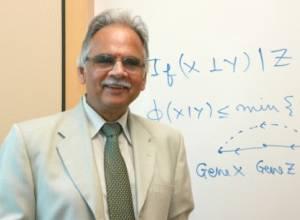
IMAGE: Professor 


Mathukumalli Vidyasagar. Photograph: Kind courtesy Professor Mathukumalli Vidyasagar

We validated the algorithm on NIH data (TCGA) and then tested it on an independent dataset from Australia with 275 samples.

I tell my students to stare at the data, not just run algorithms.

We looked and found that for 101 out of the 275 samples were wrongly entered.

We removed those 101 samples and ran the algorithm on the remaining 174. It worked perfectly.

This is a lesson: Data quality in biology is often poor compared to engineering, and you must check it meticulously.

The current AI community isn't always careful. The machine only does what you tell it to do.

If you train it on biased data you get biased outputs.

The original goal of 'machine learning' and 'neural networks' in the 80s/90s was different.

It was more about 'operational AI' -- trying to replicate the internal working of the human brain.

This failed for two reasons: 1. Our electronic switches are not reversible like the brain's chemical switches, and 2. It wasn't necessary.

The shift happened to 'functional AI' -- just getting the job done, regardless of how. The creation of large, standard datasets like ImageNet allowed people to compete purely on accuracy of image recognition, making the 'how' irrelevant.

This functional focus, combined with market hype, has diluted the original mission of AI.

A final point on the much talked about Quantum Computing and Quantum Communication.

Quantum computing is a fascinating case study of the importance of theory.

It existed only on paper for about 15 years after Feynman first suggested a quantum simulator and David Deutsch formalised it.

Theorists like Peter Shor analysed what it could; do if built, leading to the entire field of post-quantum cryptography -- devising new cryptographic schemes that would be secure even if quantum computers could break current ones like RSA.

Quantum communication, which the Chinese are advancing, is different.

It's about Quantum Key Distribution (QKD), using quantum entanglement to distribute encryption keys securely over an insecure channel.

It's not about building a quantum computer but solving the problem of secure key exchange, which is a very real and practical application.

That's a fascinating distinction. So, quantum communication is about secure key distribution today, while the full quantum computer is still a future prospect. This has been an incredibly insightful conversation, Professor.

We've covered a vast landscape, from the challenges in India's defence R&D and the story of CAIR to AI in healthcare and the philosophical shifts in computing.

Thank you for sharing your experiences and perspectives so candidly.

Shivanand Kanavi, a frequent contributor to Rediff, is a theoretical physicist, business journalist and former VP at TCS.
He is the author of the award winning book Sand To Silicon: The Amazing Story Of Digital Technology and has edited Research By Design: Innovation and TCS; a chronicle of over 30 significant outcomes and case studies of TCS R&D from 1981-2006.

Feature Presentation: Ashish Narsale/Rediff

Thursday, October 30, 2025

Interview with Prof M Vidyasagar, FRS Part 1

 The first part of my interview with Prof M Vidyasagar, FRS has appeared today in Rediff and the second part will appear soon.

https://www.rediff.com/news/interview/india-builds-best-when-it-builds-alone/20251029.htm )

Why The Americans Were Opposed To Agni

Last updated on: November 06, 2025 12:38 IST


'The heat shield technology for re-entry vehicles was first mastered in DRDO for the Agni missile.'
'This is why the Americans were so opposed to Agni in the 1980s, unlike other missiles -- it was a re-entry vehicle.'

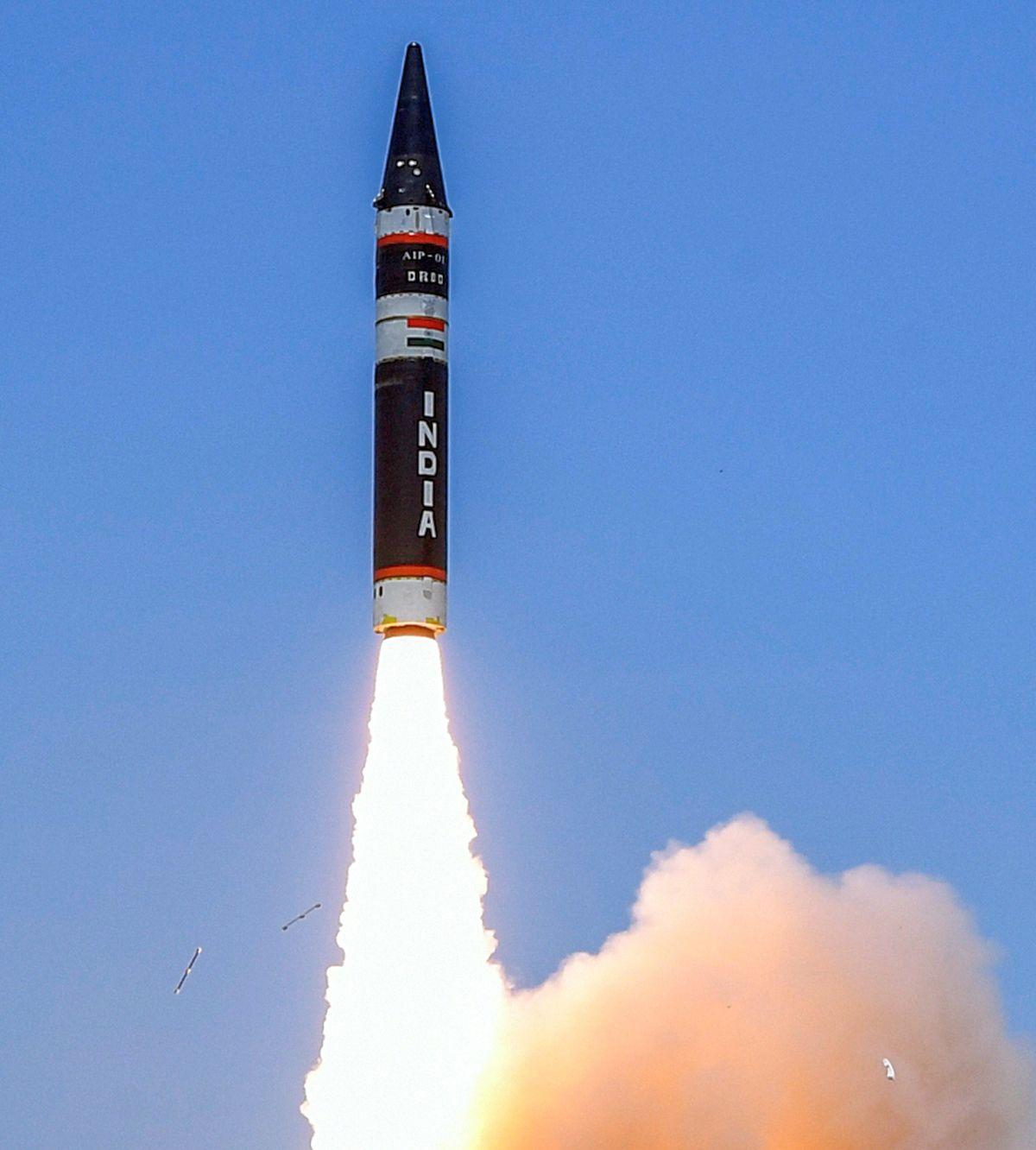
IMAGE: The Defence Research and Development Organisation successfully flight tests the new generation Agni P ballistic missile, in Balasore. Photograph: ANI Photo
 

Professor M Vidyasagar, FRS, is a Distinguished Professor at IIT Hyderabad. He earned his BS, MS, and PhD in electrical engineering from the University of Wisconsin.

His distinguished career includes academic positions at universities in the USA and Canada, followed by leadership roles as Director of India's Centre for AI and Robotics and Executive VP at Tata Consultancy Services.

He held a chaired professorship at the University of Texas in Dallas before his current position.

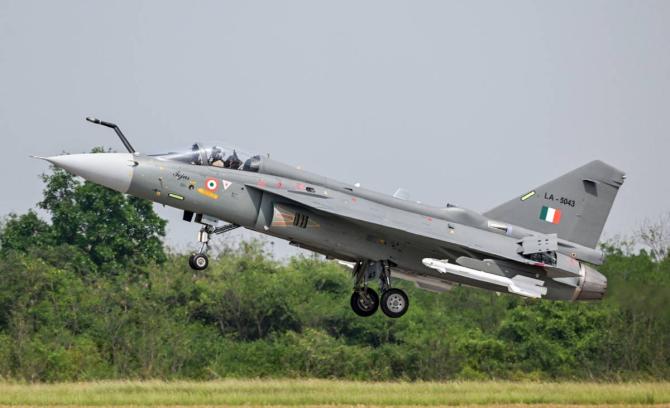
IMAGE: The LCA Tejas Mk1A takes off on its maiden flight at Hindustan Aeronautics Laboratory in Nashik, October 17, 2025. Photograph: ANI Photo

A major feather in the cap of his team at the Centre for AI and Robotics is the creation of world class digital control software for the Light Combat Aircraft Tejas indigenously.

His research interests span stochastic algorithms, convex/nonconvex optimization, reinforcement learning, and machine learning, with recent work focusing on the theoretical foundations of stochastic gradient descent and Large Language Models.

Professor Vidyasagar, a prolific author of 13 books and over 160 peer-reviewed research papers, was appointed a Fellow of IEEE (the largest professional engineering body in the globe) for his advanced contributions to Control Systems at a very young age.

His groundbreaking contributions have been recognized with numerous prestigious honours, including Fellowship of The Royal Society (FRS), the IEEE Control Systems Award, the Rufus Oldenburger Medal (ASME), and the John R Ragazzini Education Award (AACC).

He is also a Fellow of multiple national academies in India and a recipient of a SERB National Science Chair.

"I believe a significant handicap is that the critical need for our own technology to win wars has never been burned into the memory of our government and armed forces. But let's look at the positive achievements. The nuclear submarine, the aircraft carrier, the Tejas fighter, and the guided missiles programme -- including newer missiles and the excellent BrahMos joint venture -- are all visible, major system successes," Professor M Vidyasagar tells Shivanand Kanavi. The first of a two-part must-read interview.

A major feather in the cap of his team at the Centre for AI and Robotics is the creation of world class digital control software for the Light Combat Aircraft Tejas indigenously.

His research interests span stochastic algorithms, convex/nonconvex optimization, reinforcement learning, and machine learning, with recent work focusing on the theoretical foundations of stochastic gradient descent and Large Language Models.

Professor Vidyasagar, a prolific author of 13 books and over 160 peer-reviewed research papers, was appointed a Fellow of IEEE (the largest professional engineering body in the globe) for his advanced contributions to Control Systems at a very young age.

His groundbreaking contributions have been recognized with numerous prestigious honours, including Fellowship of The Royal Society (FRS), the IEEE Control Systems Award, the Rufus Oldenburger Medal (ASME), and the John R Ragazzini Education Award (AACC).

He is also a Fellow of multiple national academies in India and a recipient of a SERB National Science Chair.

"I believe a significant handicap is that the critical need for our own technology to win wars has never been burned into the memory of our government and armed forces. But let's look at the positive achievements. The nuclear submarine, the aircraft carrier, the Tejas fighter, and the guided missiles programme -- including newer missiles and the excellent BrahMos joint venture -- are all visible, major system successes," Professor M Vidyasagar tells Shivanand Kanavi. The first of a two-part must-read interview.

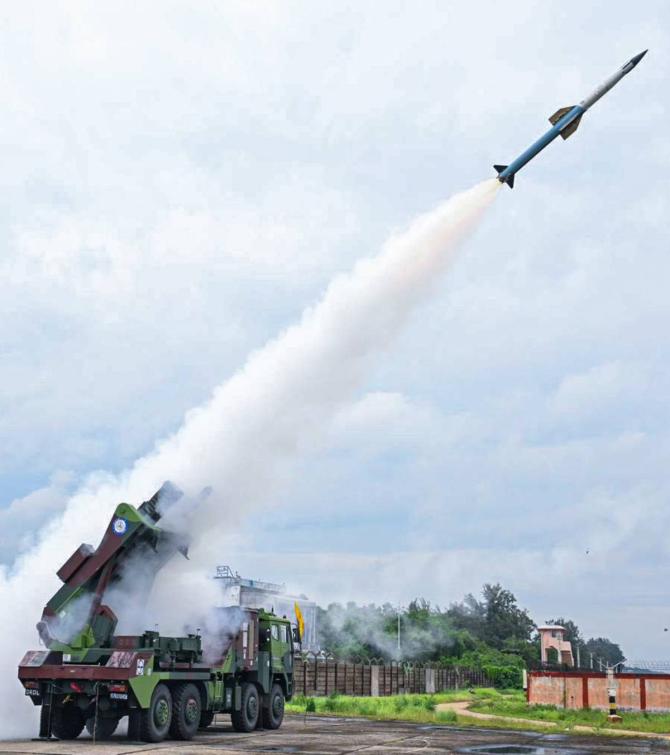
IMAGE: DRDO successfully conducts the maiden flight test of the Integrated Air Defence Weapon System off the coast of Odisha. Photograph: @rajnathsingh X/ANI Photo

Thank you for your time, Professor Vidyasagar. There are many diverse things I want to talk to you about in which you have great expertise and experience. To begin with, what have been the major achievements of the Defence Research and Development Organisation (DRDO)?

DRDO has done extremely well in areas where it hasn't had to compete with the 'import option'.

Take missiles, for example. If you want a missile, you have to build it yourself; nobody will sell it to you.

This is also how ISRO succeeded -- you can't import a satellite launch vehicle.

In such segments, DRDO and ISRO come out looking very good. They have good scientists, but they also aren't constantly watching their backs against import lobbies.

Take for instance, the ring laser gyroscope developed by DRDO under the Integrated Guided Missile Programme.

Older missiles used mechanical gyroscopes; the new laser gyroscope is far more accurate.

Nobody would give that to us, so DRDO developed it indigenously.

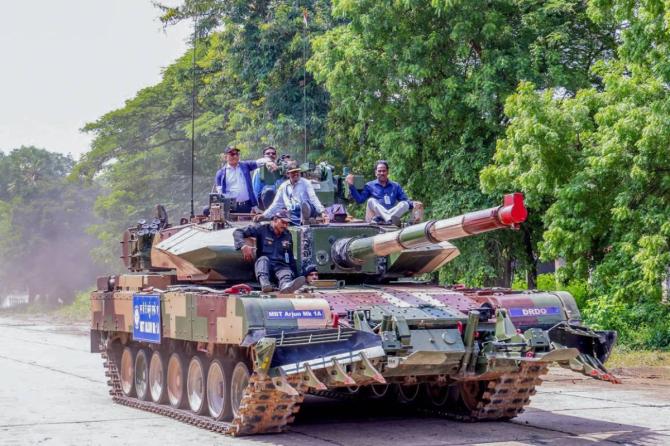
IMAGE: The indigenous MBT Arjun MK-1A tank. Photograph: DRDO/ANI Photo

However, in areas where an import option exists -- like fighter jets, main battle tanks, or towed artillery guns -- the moment DRDO gets close to a solution, someone shows up offering to sell it.

The sellers also have an interest in undermining DRDO.

What I've never understood is what's in it for the buyers, our government of the day and armed forces?

I believe a significant handicap is that the critical need for our own technology to win wars has never been burned into the memory of our government and armed forces.

But let's look at the positive achievements.

The nuclear submarine, the aircraft carrier, the Tejas fighter, and the guided missiles programme -- including newer missiles and the excellent BrahMos joint venture -- are all visible, major system successes.

There are also numerous critical subsystems developed that aren't as visible.

For example, the heat shield technology for re-entry vehicles was first mastered in DRDO for the Agni missile.

This is why the Americans were so opposed to Agni in the '80s, unlike other missiles -- it was a re-entry vehicle.

We also had to master the technology of mounting printed circuit boards in these missiles that can withstand extreme shock, vibration, and temperature.

The US had a far better ecosystem for spinning off military technology for civilian use --Teflon came from the space programme.

DRDO could have done this, but it was stifled by financial and ideological hurdles.

When Dr Kalam was director general of DRDO, we explored commercialising DRDO technology.

The problem was the finance ministry was terrified that an industry might buy a license and make a fortune.

Our attitude was DRDO has no mechanism for marketing, scaling up, or paying competitive salaries.

If we don't commercialise, the technology will die. Let someone take a chance and commercialise it.

But the officials were scared of audit objections from the CAG.

Their solution was to ask for a ridiculous amount of money upfront to avoid any future allegation of underpricing.

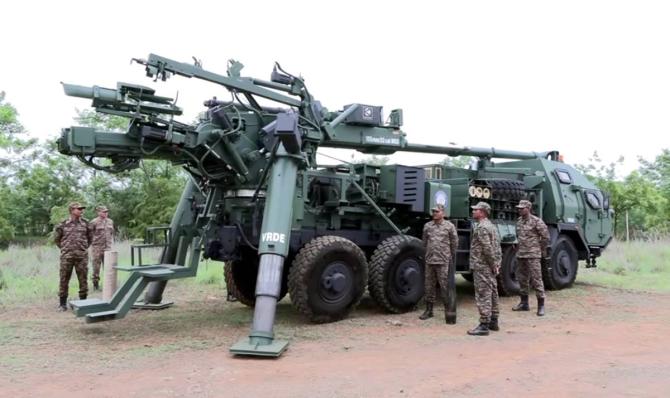
IMAGE: The Mounted Gun System indigenously developed by involving Indian industry, defence public sector units and academia, under the leadership of DRDO, displayed at the Vehicles Research and Development Establishment in Ahmednagar. Photograph: Video Grab/ANI Photo

If we had adopted a model of taking a small royalty or an equity stake in the commercialising company, many small technologies could have proliferated into society.

Unfortunately, that model was unthinkable in the '90s. This resistance has prevented the diffusion of many technologies.

Fortunately, some groups with deep pockets like the Tatas can take chances.

For instance, some drones used abroad are actually made by a small, young entrepreneurial company in Hyderabad -- not a big corporate.

For example, armour-penetrating explosives could have had mining and other civilian applications. Similarly the laser gyro, heat shield etc.

The commercialisation never took off because our finance people were scared to make decisions.

I don't necessarily blame them; they fear audit objections. The whole system is messed up.

This is also why government startup funds often go unspent -- no one wants to take the risk inherent in venture capitalism, where you expect many failures for one big success.

This culture of audit objections stifles innovation, and no government, including the present one, has shown the willingness to truly understand and fix this problem.

You were the founder director of the Centre for Artificial Intelligence and Robotics (CAIR) at DRDO. Please tell me how that came about and what was achieved there.

It was an interesting time.

I was a professor at the University of Waterloo, Canada; at the top of my academic career, but my wife and I always wanted to return to India.

In 1987, I took a sabbatical and met Dr Kalam at DRDL (Defence Research and Development Laboratory) in Hyderabad.

I was struck by how hard everyone was working -- a testament to the impact of a charismatic leader.

I told him I was thinking of returning to India, and he said he'd look for an opportunity.

In September, just two months later, he told me that Dr V S Arunachalam, the scientific advisor to the defence minister, wanted to start a project on AI but couldn't find a leader.

He asked if I would lead it. I was interested but had to finish guiding my four PhD students in Waterloo.

I asked for a year's joining time, which was agreed upon.

When I joined DRDO, the 'CAIR Project' had a two-year lifetime in government terms.

My first task was to turn this project into a permanent establishment -- a laboratory.

This required navigating bureaucracy and defining what we would do.

I was met with tremendous goodwill, primarily because in 1989, the idea of a well-established academic returning to India was almost heretical. It rarely happened.

We defined our areas: In artificial intelligence, we started with rule-based expert systems and quickly moved to neural networks, which had just emerged in 1986.

In robotics, we coordinated with BARC's (Bhabha Atomic Research Centre) strong Division of Remote Handling and Robotics, led by the amazing Ram Kumar.

We decided that anything in a radioactive environment would be handled by BARC, and anything outside that would be our domain.

We were primarily an internal consultant for DRDO, not expected to build finished products but to be an in-house resource.

For example, we built a fault detection expert system for a radar being developed by LRDE.

We also developed a robotic system to uniformly coat the canopy of the Light Combat Aircraft with radar-absorbing material -- a critical stealth technology, as the canopy is the most reflective part of an aircraft.

We also did basic research. I probably had the highest percentage of PhDs in any DRDO lab.

By 1994, we had about 40 scientists and 80-85 people total, including support staff.

To get hiring flexibility, we set up a non-profit society called the Institute of Robotics and Intelligent Systems (IRIS), with the DRDO secretary as the ex-officio chairman.

This allowed us to hire on contract and pay somewhat higher salaries.

Our biggest success was the control law for the LCA.

It started around 1992. Girish Deodhare, who just retired as DG of ADA, was my PhD student at Waterloo and joined CAIR.

Dr Kota Harinarayana was the programme director of ADA.

Initially, Martin Marietta was supposed to design the control software. They would talk big but belittle Indian capabilities and refused to share design documents, only giving final numbers.

Dr Kalam, who took over as DG in July '92, called a meeting -- on a Sunday -- and appointed Professor Roddam Narasimha FRS, to head a committee to decide if we could build the control law indigenously. We all said we could.

These foreign companies weren't impressive technically and weren't offering a knowledge transfer.

We decided to go for a state-of-the-art digital fly-by-wire control with a 32-bit floating-point processor, which was advanced for the time.

Professor Narasimha recommended we do it ourselves, and Dr Kalam agreed. He appointed Professor I G Sharma of IISc as an independent assessor to report to the ADA governing council every three months.

We designed the first cut of the control law in about two years.

A major hurdle was computing power. Due to international restrictions, we couldn't get powerful computers in India.

We rented time on a British Aerospace flight simulator in the UK.

Our team would go there with the software on tapes, and our test pilots would fly the LCA control law on that simulator.

Interestingly, the BAE guys, who were also working on the Eurofighter, invited our pilots to try their simulator.

Our pilots later reported that they found the LCA's handling qualities to be better!

The control law's quality is best attested by the fact that the LCA is the first fighter aircraft in the world to be inducted into service without a single crash during its development phase.

Because it was completely in-house, and the test pilots who flew it eventually rose to senior decision-making positions in the air force, the system was well-accepted even though the import option always loomed.

The economics also flipped. In 1989, the assumption was that the LCA would be three times more expensive than a Mirage but would be ours.

Twenty years later, it was not only ours but also only 25%-30% of the cost of any imported equivalent fighter alternative.

There was an export market for an affordable, capable fighter, but we lacked the production capacity and the mindset to engage a private sector partner for mass production and marketing.

The ingrained mindset, fearing 'someone might make money', prevented this.

HAL's production rate was initially 6 per year, then 18 -- we need 50 to 60 per year to meet demand and export.

We see the same issue today with the Advanced Medium Combat Aircraft (AMCA).

The project was 'sanctioned' two years ago, but not a single rupee has been released.

Most people don't know that government sanction means expenditure power for when money is released, not that funds have been allotted.

Many times I doubt if our armed forces are serious about wanting indigenous equipment; they seem to delay until they can claim an urgent need to import.

Countries like the US field-test their equipment in local wars in the globe, creating testimonials for their technology.

In India, field trials are often used as an excuse to delay induction.

-----------------------------------------------------------------------------------------

Shivanand Kanavi, a frequent contributor to Rediff, is a theoretical physicist, business journalist and former VP at TCS.
He is the author of the award winning book Sand To Silicon: The Amazing Story Of Digital Technology and has edited Research By Design: Innovation and TCS; a chronicle of over 30 significant outcomes and case studies of TCS R&D from 1981-2006.

Feature Presentation: Ashish Narsale/Rediff